哈Ha!在本文中,我将向您展示如何对现代俄语Internet语言进行频率分析并使用它来解密文本。谁在乎,欢迎下切!

俄语互联网语言的频率分析
社交网络Vkontakte被用作来源,您可以从中获取大量使用现代Internet语言的文本,或更准确地说,这些是对该网络各个社区中出版物的评论。我选择了真正的足球作为社区。为了解析注释,我使用了Vkontakte API:
def get_all_post_id():
    sleep(1)
    offset = 0
    arr_posts_id = []
    while True:
        sleep(1)
        r = requests.get('https://api.vk.com/method/wall.get',
                         params={'owner_id': group_id, 'count': 100,
                                  'offset': offset, 'access_token': token,
                                   'v': version})
        for i in range(100):
            post_id = r.json()['response']['items'][i]['id']
            arr_posts_id.append(post_id)

        if offset > 20000:
            break
        offset += 100
    return arr_posts_id

def get_all_comments(arr_posts_id):
    offset = 0
    for post_id in arr_posts_id:
        r = requests.get('https://api.vk.com/method/wall.getComments',
                         params={'owner_id': group_id, 'post_id': post_id,
                                 'count': 100, 'offset': offset,
                                 'access_token': token, 'v': version})
        for i in range(100):
            try:
                write_txt('comments.txt', r.json()
                ['response']['items'][i]['text'])
            except IndexError:
pass结果是大约200MB的文本。现在我们考虑遇到哪个字符多少次:
f = open('comments.txt')
counter = Counter(f.read().lower())

def count_letters():
    count = 0
    for i in range(len(arr_letters)):
        count += counter[arr_letters[i]]
    return count

def frequency(count):
    arr_my_frequency = []
    for i in range(len(arr_letters)):
        frequency = counter[arr_letters[i]] / count * 100
        arr_my_frequency.append(frequency)
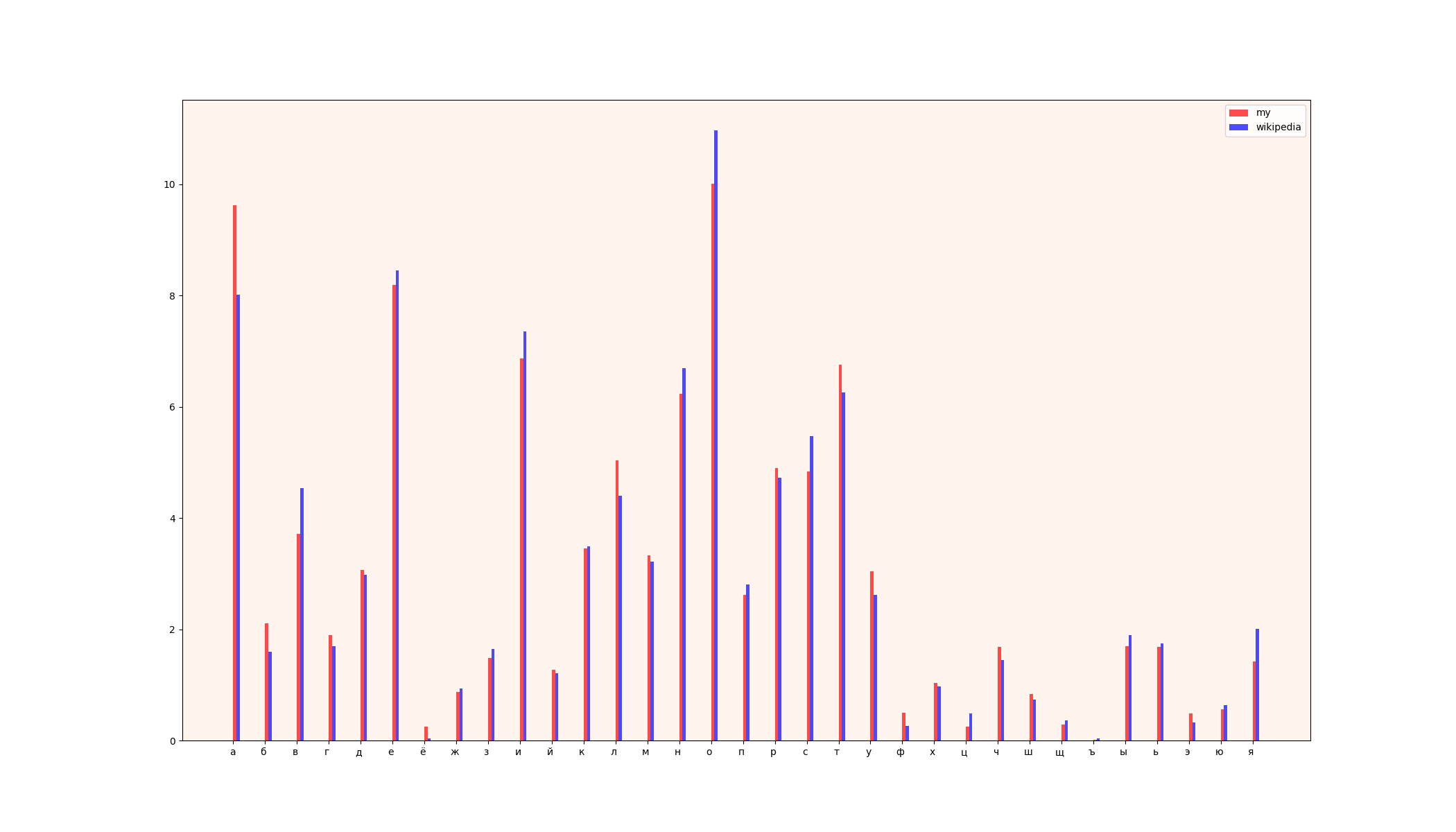
return arr_my_frequency可以将获得的结果与Wikipedia的结果进行比较,并显示为:
1)比较表
2)表格(左-维基百科数据,右-我的数据)
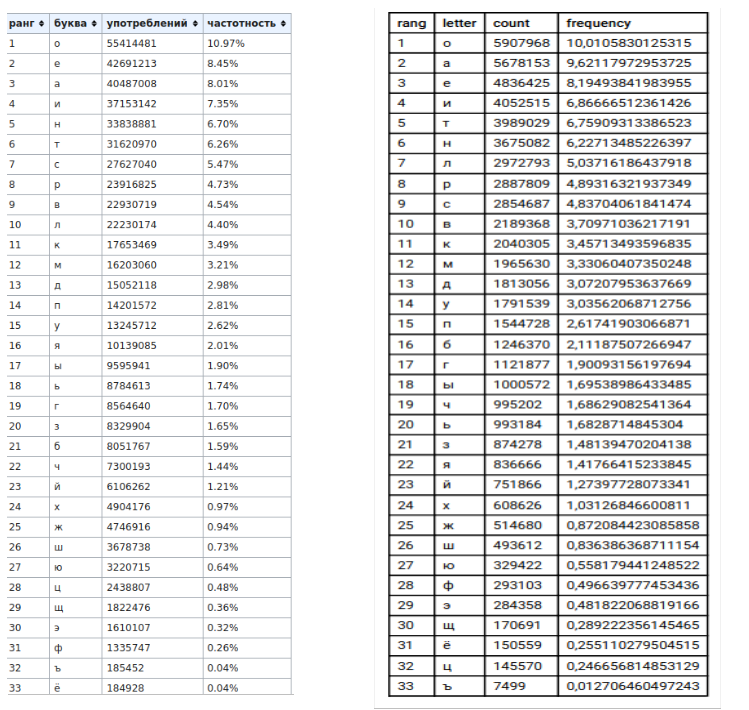
, , , «» «».
, , 2-4 :
, , , , , , , , ,
- . , — , , :
def caesar_cipher():
    file = open("text.txt")
    text_for_encrypt = file.read().lower().replace(',', '')
    letters = ''
    arr = []
    step = 3
    for i in text_for_encrypt:
        if i == ' ':
            arr.append(' ')
        else:
            arr.append(letters[(letters.find(i) + step) % 33])
    text_for_decrypt = ''.join(arr)
    return text_for_decrypt
:
def decrypt_text(text_for_decrypt, arr_decrypt_letters):
    arr_encrypt_text = []
    arr_encrypt_letters = [' ', '', '', '', '', '', '', '',
                           '', '', '', '', '', '', '', '',
                           '', '', '', '', '', '', '', '',
                           '', '', '', '', '', '', '',
                           '', '', '']
    dictionary = dict(zip(arr_decrypt_letters, arr_encrypt_letters))
    for i in text_for_decrypt:
        arr_encrypt_text.append(dictionary.get(i))
    text_for_decrypt = ''.join(arr_encrypt_text)
    print(text_for_decrypt)
如果您查看解密后的文本,则可以猜出我们的算法出了什么问题:打架→确实如此,视频→广播,东宝→加法,压倒性→人。因此,可以解密整个文本,至少可以掌握文本的含义。我还想指出,此方法仅对解密使用对称加密方法加密的长文本有效。完整的代码可在Github上找到。